Showing posts with label Nashville Warbler. Show all posts

Monday, June 13, 2022

Two (Moku Hanga) for 2022


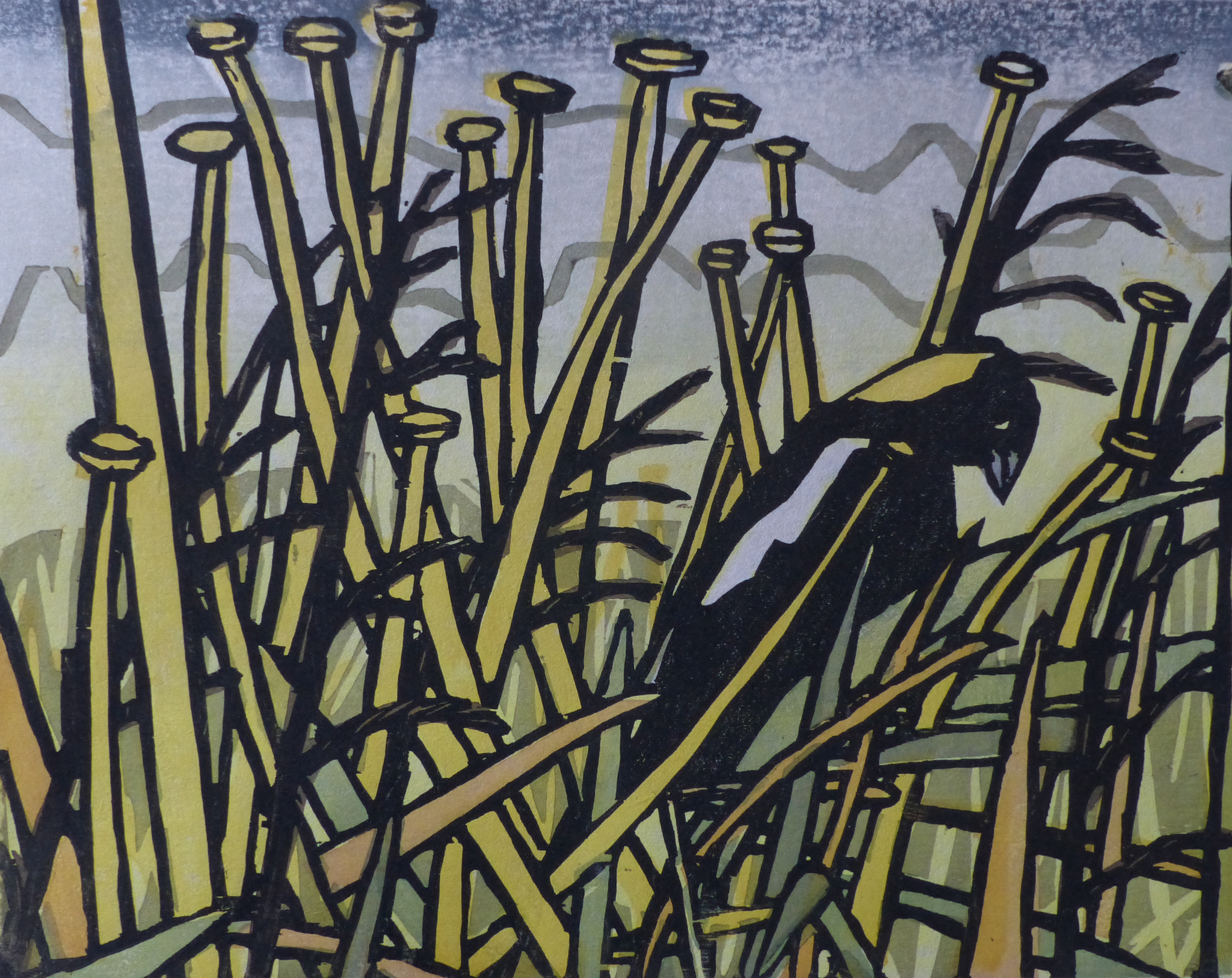
Original Moku Hanga of Nashville Warbler on Bean  Trellis in Winter. Copyright  2022 by Ken Januski

Original Moku Hanga of Bobolink at Dixon Meadow. Copyright 2022 by Ken Januski.

I've finally finished my second Moku Hanga of 2022, this one a revisit of my first one ever: Nashville Warbler on Bean Trellis in Winter. I don't believe I ever showed the final version of the Bobolink at Dixon Meadow so I'm showing it as well.

It's not surprising that I did another version of the Nashville Warbler. Being my first moku hanga ever and being done with exactly no training in the art/skill/process it came into being more through will power, trust in my artistic abilities regardless of medium as well as sheer terror at all that was going wrong as I proceeded trying to print an edition!! And yet I still liked it, and it seems some other people did as well. But there was absolutely no consistency from print to print so I removed it from sale.

In the five plus years since I made the first version I've learned a lot. As I think I wrote previously about the International Moku Hanga Conference last December I learned a lot from presentations there, but I also had my ambitions raised. As with wildlife art when I first ran into The Society of Wildlife Artists I had to run into some accomplished artists in the field to see all that was possible and also I'd say to translate the ambitions I used to have in my abstract work into wildlife art, except here it was to moku hanga. One of the surprising things about the conference and other smaller online meetings that were an outgrowth of it was the discovery of what a great variety of accomplished and contemporary moku hanga there is out there in the world.

All of that I think informed these prints, as well as my continued desire to portray the natural world, something for which I don't make the slightest apology. If you're not smart enough to see that it is just as valid as any other 'subject' that is your blindness, not my anachronistic romanticism about nature. I think just about anything can be the subject of art, including wildlife.

But that is a bit of tangent. I really don't have a lot to say about these prints except to say that in the newest one I did a lot of experimenting on the background. I wanted it to be vibrant but I also wanted it to evoke in some way the very inhospitable weather we had when the Nashville Warbler was in our yard many winters ago. In that experimentation I  ended up varying what I printed even in the final edition. So these prints will be called e/v for Edition Varie. But I also found that I was getting tired of tossing prints from the edition, often each of which might have a few hours devoted to it, because of small blemishes.

I can understand the tradition of only choosing prints that are identical, that are without blemish of any sort, etc., etc. If I'd trained as a printmaker perhaps I'd believe in it as well. But it seems to be that there is a tyranny there, that values the skill of the printer over the artistic quality of the artist, who sometimes is the printer as well, especially in most modern moku hanga.

In fact almost everything is done by hand, by one person in modern moku hanga. I'm just guessing but with five blocks on my new print, multiple printings of some of the blocks and multiple colors as well on some that this leads at least to 10 impressions for each print, 10 times that something can go wrong, often just the slightest thing. I have been relatively strict in culling out prints in the past that have had very minor blemishes. But I'm getting more and more reluctant to do so given the work involved. So when I finally number the edition of the Nashville Warbler I may include more prints that I normally would. I think that this is a step in the right direction.

Otherwise I think printing can just become too inhibiting and just not worthwhile from an economic perspective as well as psychological perspective. Rules should not stamp the joy out of it. This I'm sure will rankle at least some print collectors. But my feeling toward them would probably be the same as it is to those art collectors who won't accept any thing out of order in the feather details of birds. Those demands are just too inhibiting I think for the serious artist to bother with.


Monday, February 20, 2017

First Moku Hanga Print

Nashville Warbler on Bean Trellis in Winter. Moku  Hanga Print by  Ken Januski.

For quite some time I've debated trying Moku Hanga printmaking. As best I can tell the term itself just refers to Japanese woodblock or  woodblock  printmaking. Most  people will probably be familiar with it through ukiyo-e prints, such as those by Utamaro, Hokusai, Hiroshige et al.

Though I've always liked those prints I suspect I first liked them more for their influence on the art of people  like Edgar Degas than for any other reason. That is no longer the case but it was my first reaction to them. Now my interest is completely different. It is more related to things like the use of  non-toxic materials(since the ink  is water-based not petroleum  based), the fact that it can be done without a printing press, though this has been true  of all my other prints as well, that it has a registration system that most likely is  better than the one I've used in the past, and perhaps most of all it is capable of a rich color, a color that actually is absorbed into the paper, rather than lying  on top of it.

Though I'd read the last statement before, the fact that the color merges with the paper,  you  actually need to see it to understand it. Now I have! It can be seen in the two prints above and below of a Nashville Warbler  on a Bamboo Bean Trellis in Winter,  which we had in our backyard on and off over a two week period a number of winters ago.

These two prints also show at least one of the problems with this type of printmaking:  the background color, in particular, varies greatly between prints. I began printmaking about 5-6 years ago I  think, though  I had had a brief introduction in college. The more I've done it the more I  remember why I shied away from it in college. Printmakers seemed SO interested in technique! At the time that was the last thing that I thought art should  be about. But after my 5+ years of printmaking I realize that technique is an integral part of  it,  at least if you want to make an edition, i.e . more than one more or less consistent print  of the same image. And given all the work involved, at least when I make a print, it seems silly to not have more to show for  it than just one print.

Still I don't like having to worry about technique. It's a necessity, not a virtue, not something I seek out. That said I've seen some moku hanga prints that are extremely rich in color and that is  something that I think is desirable enough to more than compensate for  the technical problems involved. At least I hope so! Time will tell.

Another thing I love in many ukiyo-e prints is the sinuous, graceful line, based most often on the sinuous, graceful line of the original brush paintings on which the prints were based. For  me there at two huge obstacles to doing this myself: first I can't do graceful, sinuous brush paintings, and to do so would  probably take  years  of practice; and second, I'll never  become such an accomplished carver of wood as to translate sinuous lines from paint to carved wood. In ukiyo-e prints this was no problem because the artist and the carver were two different people! And the printer was a third person involved in the process. This helps to explain some of the accomplishments of this type of print. And it also shows the difficulty of doing it today.

There seem to be quite a few contemporary Western printmakers using moku hanga today, each in their own way. From what I can see many skip the part based on graceful, sinuous lines and instead are more interested in rich color fields. I know of some art in this manner that I greatly like. But it's not for me, at least not at the moment. So crude as my lines might be I plan to continue  to use  them in my prints. Only time will tell how I come into my own interpretation of moku hanga.  Above and below you see the first.

Nashville Warbler on Bean Trellis in Winter. Moku  Hanga Print by  Ken Januski

All printmaking seems to require a lot of time in the studio. So I was happy a couple of  times recently to  leave prints and printmaking behind and head outside. Below you see two recent field sketches. As you may be able to tell they are done with a brush pen, something that resembles a Chinese  or Japanese brush but that comes with a reservoir of ink. It may be hard to believe but when I first started using them a year or two it was with the idea of developing the sinuous, graceful line that I talked about above. I find it far more refreshing that a labored pencil sketch,  at least for myself.

Great Blue Heron and Killdeer at Manayunk Canal. Brush Pen Field Sketch  by Ken Januski.

Two Great Blue Heron in Trees Along Manayunk Canal. Brush Pen Field Sketch by Ken Januski.

Monday, August 31, 2015

Confusing Fall Warblers, And Vireos

Warblers and Vireos at Morris Arboretum. Sumi Brush Pen and Watercolor Painting by Ken Januski.
 

I ran into a large number of migrating warblers and vireos at Morris Arboretum last Saturday. But I had hardly any satisfying views of any of them. Some, for example a Blackburnian, were just too high in some Tamaracks to see well. Others were down low, right at eye level, but they were so active and there was so much foliage that again it was very difficult to get a good look at any of them.

The 12x16 painting above gives some sense of that. A Nashville Warbler in the lower right corner was the best seen bird, with the possible exception of the Warbling Vireo in the top right corner. The other were just yellow blurs, or a tail with black edging, perhaps fluttering wings.  Some of the quick looks were tantalizing, for instance the largish yellow bird at center top, but as soon as they were seen they flew behind other foliage.

Most likely the yellow bird was a Canada Warbler, especially as we've seen one at Morris two other times during the last week. But I can't say for sure.

Because of all of this uncertainty I decided to paint just that: uncertainty.  So I'm not trying to portray a recognizable species at center top. Instead it's reminiscent of what I saw. The fluttering wing at lower left and tail at top left don't indicate specific species. They represent instead the real experience that you can easily have at this time of year. Uncertain clues, here and gone before you know it. But that is the thrill of looking for warblers and their sometime companion vireos at this time of year.

This is another in my series of sumi brush pen and watercolor paintings. All but the Nashville warbler are drawn from memory. I used some of my own photos of Nashville Warblers as a minor reference. But in it also I tried to keep it free as in a drawing from memory.

Monday, March 11, 2013

A Weekend Without Warblers


Nashville Warbler Sketch by Ken Januski

Prairie Warblers Sketch by Ken Januski

Prothonotary Warblers Sketch by Ken Januski

A weekend without warblers would indeed be a disappointment if it were April or May, especially if I'd been out birding and wasn't limited to my yard. Warblers are quite rare in the backyard, visiting briefly once or twice a year at most. Most of those are Common Yellowthroats. But who can complain about a weekend in March without warblers in the backyard?

Well I and Jerene can but I'm sure we won't get much sympathy.We were lucky enough to have a Nashville Warbler in the backyard for the two weekends before the last one. But we last saw him on March 6. Since he'd previously eluded us for a full week it seemed possible he might still be around but I'm pretty confident now that he's gone for good.

I did try briefly on the day of his last visit to do a field sketch, something I also tried on the day of his first visit. But he left almost instantly and we haven't seen him yet. Was he really that shy? I'm sure that wasn't the cause of his departure! But it did remind me of how difficult it is to draw warblers, even if they manage the unheard of behavior of sitting still, without the aid of magnification.

The details, such as the size and shape of bill, just can't be seen with the naked eye. I took a lot of photos of this bird, more for documentation purposes than anything else. But now that I have them I see how much I missed when just looking with my naked eye.

One of the first impressions Jerene and I had of the Nashville, before we'd identified it  and I think  even before we'd gotten out our binoculars was how long his bill was. And yet when we read about him later I recall that the guides said he had a short bill. Why the difference? This is something that I think comes out in photos or with optics, the true cause of an overall visual impression. The Nashville has a particularly pointed bill. That I think is was made it seem so long when we first saw it.

That in turn got me thinking about other warblers and their bills. The Prothonotary always strikes me as  having a long bill, though nothing like that of the Yellow-throated Warbler. The Black-throated Blue on the other hand seems to have a bit of a stubby bill. These are my impressions and recollections anyway. I'm sure many birders don't notice bills. They're too busy checking all of the more obvious diagnostic marks used for an ID. More experienced birders of course probably are well aware of these details.

In any case the differences in bill shapes of warblers convinced me that I should go through my photos of warblers and do some sketches, trying to capture both the general shape of them, but also their specifics, like bill shape. That is what I've done above with the Nashville from the backyard, some Prairies from near Belleplaine State Forest in New Jersey and some Prothonotaries from Magee Marsh in Ohio. Often the photos still weren't good enough to see all I needed to see. At other times my skills weren't high enough. But it's been a useful exercise and one I hope to continue with other warblers.

The first normal migrants will soon be here. I'd like to be ready for them. Into the breach one more with field sketches of wood warblers!

Sunday, March 3, 2013

Nashville Warbler Revisits

Nashville Warbler at Suet Feeder


Nashville Warbler at Suet Feeder
I was a bit reluctant to title yesterday's post Revisting Nashville Warbler because I didn't want to mislead people into thinking that the bird had returned. It hadn't. A week had gone by with no sighting.

Last week my wife Jerene yelled out loudly "Get Down Here Right Now." There was the Nashville on our feeders. Today she yelled out "There's a bird I don't recognize on the suet." Sure enough it was the Nashville, and allowing better photos than last week.

Who knows how he got here but he seems to be sticking around, at least in the general vicinity.

Saturday, March 2, 2013

Revisiting the Nashville Warbler

Nashville Warbler on Bean Trells, February 2013. Watercolor by Ken Januski
When we saw a Nashville Warbler in our backyard last Saturday it was hard to know what to do first: get the binoculars so we could confirm what it was? Get the camera so I could photograph it? Try to do a sketch? Notify other local birders via the PA Rare Bird List?

I took steps one and two first, view him through the binoculars and then run upstairs and get the camera and try for some photos as he flitted in and out of sight for 30 minutes or so. I probably made a mistake with step 3, which is alert local birders. As with any rare bird it makes most sense to see it as well as possible as long as possible and get proof of the bird, either verbal, visual or both.

When I came back down after posting the two blurry photos to the bird list I don't think we ever saw the bird again. I assumed that we'd see him later in the day,  especially as he probably wasn't going to fly anywhere in the rain. But we never saw him again that day or the next few days.

I did a quick watercolor that I posted here but it was unsatisfactory in many ways. Since then I've wanted to do a better version, one that was more accurate in shape and color and also more a finished painting. That is it at top, a smallish 7x10 watercolor on 300# Arch cold press paper. I think it does justice to such a rare scene.

I did look on ebird in the following days to see if I could find any other nearby sightings. Though I didn't try every state the closest one I found was Texas!
Killdeer, Great Blue Heron, Snow at Manayunk Canal. Watercolor by Ken Januski


The watercolor above is a reworking of the earlier watercolor of the Killdeer and Great Blue Heron seen at the Manayunk Canal a number of weeks ago. It's the earliest I've ever seen a Killdeer in Philadelphia and I wanted to commemorate it, and the snow and Great Blue Heron in a painting. This was also the second version, but I still wasn't happy with it when I finished it a couple of weeks ago. It just didn't seem to vibrate in terms of color or value. I felt I hadn't taken advantage of a special scene. So I reworked it yesterday for the Manayunk Roxborough Arts Center Members Show. It's not perfect but I think much better now.

Monday, February 25, 2013

Speaking of Warblers - 2013

Cape May Warblerat Magee Marsh. Watercolor by Ken Januski

Cape May Warbler at Magee Marsh. Watercolor by Ken Januski

Every Junco that flies across the backyard makes my heart skip half a beat, hoping it's the return of the Nashville Warbler from Saturday. I still have some vague hopes of seeing him, based solely on my experience with birds that seem to be one-hit wonders, then reappear. But we only saw him for a 30-60 minute period and my guess is that he is gone.

While looking through some of my photos today I ran across a number of a Cape May Warbler drying himself off after a bath in one of the small meandering streams at Magee Marsh in Ohio, right next to the boardwalk. Since there's a Members' Show at the Manayunk Roxborough Art Center this weekend and I'd like to put in something new I decided to experiment once again with the Cape May.

I've tried this once or twice before without much success but they're such beautiful birds, perhaps my favorite of the wood warblers, that I decided to try one more time. I modified the watercolor on Tuesday morning so the newest version is at top. As I've said many times I don't like working strictly from photos. That was reinforced in my recent rereading of the new Bob Kuhn book when he said that he could always pick out a painting based strictly on photos. I believe that's true. It tends to look a bit stiff and lifeless because only someone who really knows birds knows how to take liberties with them to make a better painting. I'm just not familiar enough with Cape Mays to be comfortable with them. So this relies much more on a photo than I'd like. Still it didn't make sense to let that limitation stop me. I guess I'll just have to see more breeding Cape May warblers and get more familiar with them.