Showing posts with label field sketch. Show all posts

Thursday, September 3, 2026

I Walked by a Sora, and Thought of 'The Natural Eye'

Three of my framed mokuhanga prints, about ready to be shipped to 'The Natural Eye' at The Mall Galleries in London.
 

I was walking through our kitchen this morning and saw a photo of a Sora on a calendar on a wall. I had to stop and look. How often do I get a good look at a Sora? What more could I learn about if from what I saw? Wouldn't it be great to be able to draw it from life again? All of those thoughts reminded me of something else I've been thinking about recently, all the various reasons to draw, and also this year's annual exhibition of the Society of Wildlife Artists' called 'The Natural Eye 2026.'

I have been showing at this juried exhibition since 2011, with a couple of off years early on where VAT requirements were just too complicated for me. It is always a thrill to have some of my work accepted for the show, and it is equally thrilling to actually see the show, just once in person in 2018 though that included 5-10 visits, but most of the time through online view by Mall Galleries and other online coverage. You walk out with a spring in your step.

I've often tried to explain why this is really the only exhibition I really care about getting into. I'm not sure about how successful I've been. But seeing the Sora on the wall got me thinking about it. If you've never actually seen a Sora I think, at least if you're interested in birds, you woiuld like to see one. But if you're an artist you'd like to see it well, and you'd like to see it well enough and long enough to see all the things that you find necessary in order to portray it. For me it always comes down to structure. How does the entire bird fit together. How does the bill relate to forehead and chin? Where is the eye in relation to bill? How does the head curve in the back? What is the conglomeration at the back of ther bird? Are the primary feathers and tail feathers in there somewhere? For me if you don't understand the structure on any bird, both generally and specifically, then you will have a hard time being accurate. 

 For me I'm also concerned with color. So as an artist you ask yourself what colors are there? What type of yellow would use for that bill. Where does the black near eye come in and how extensive is it? How does it relate to the other colors, including the grayish violet, and all the rich browns? I could go on and on. And then there is the marking on plumage. What color are they, where do they begin and end, are they too small even to paint without looking labored? For many artists this plumage detail seems to be the main thing. It is definitely not for me. But I understand how mesmerizing it can be.

But if you've seen many sora, or any bird actually, you, or at least I, have to think about movement? I almost physically empathize with the weight distribution of bird, almost feeling the stretch as it reaches out for possible food. Maybe that sense of movement is more important than plumage. It is for me.

And of course there is the environment that holds the bird. Reeds and mud, often for soras, with dark water often extending back into the reeds. A million other environments for a million, more or less, other birds. What do you do about them? It is a challenge you want to avoid or maybe something equally as interesting, at least to the artist, as the bird itself?

And all of this more or less supposes you want some sort of 'realistic' portrayal. Maybe you don't.

Brushpen and waterbrush sketches of Megachile bees, based on my photos. Copyright 2026 by Ken Januski

Most of the edition of 'Warbling Vireo, Common Yellowthroat and Wilson's Warbler at Roxborough Reservior' mokuhanga. Copyright 2026 by Ken Januski

Brushpen, waterbrush and watercolor sketch of Sachem Skipper. Copyright 2026 by Ken Januski.

Brushpen and waterbrush sketch from life of Carolina Wren on  our feeder. Copyright 2026 by Ken Januski.


What I"m trying to get at, even with a photo of a bird on a wall, let alone a live bird, is that there are an incredible number of decisions an artist can make about how to portray the bird. I've just listed some. In the tiny sketch of the Carolina Wren above I think it is done. What more could I possibly add to it without stripping the life from it? The same is true to some extent of the watercolor from a photo of the Sachem Skipper above it. What more could I do without making it a bit lifeless? But some people would like more detail, possibly enough detail that it might help them identify it, as in a field guide. This is a real goal of some artists, but it is not mine. But it's still a legitimate goal of many artists. And many artists desire some sort of accurate portrayal, one that satisfies their own artistic desires, but isn't really something to use as an aid to identification.

My point is that there are just so many different methods and goals an artist can have when portraying wildlife.  I don't know of any other exhibition that even comes close to showing that variety, ands showing it at a high level, as 'The Natural Eye.' There is a feeling of great accomplishment in accuracy of realistic portrayal with more traditional means, and there is great accomplishment of equal accuracy with completely nontraditional means. There is art that covers an incredible variety of 'wildlife' subjects, subjects that I'm sure some of the audience at the show has never even seen portrayed in art before.

And as the prospectus says more or less, it would like art that captures the spirit of the natural world. That is more than just plumage detail though that can be part of it. But people who spend time outside, who see the natural world and appreciate it, can also sense it in art in front of them. There is art that is only based on a photo and there is an art that indicates a real understanding and appreciation of nature, even if it sometimes has the 'accuracy' of a photo. I think that is why you, or at least, I left the show I saw in person with a spring in my step. It is a joyous show, celebrating nature in all its forms.


Brushpen and waterbrush field sketch of local Peregrines. Copyright 2026 by Ken Januski.

Brushpen and waterbrush field sketch of local Peregrines. Copyright 2026 by Ken Januski.

Brushpen, waterbrush and watercolor sketch of Wilson's Warbler from my photo. Copyright 2026 by Ken Januski.


Partial edition of 'Cedar Waxwings in Junipers' mokuhanga. Copyright 2026 by Ken Januski.


Brushpen and waterbrush sketch from life of Northern Cardinal outside studio window in rain. Copyright 2026 by Ken Januski.


In showing so much of my own work I'm just trying to show the various ways that I approach art, in very quick sketches done in about a minute, to an edition of mokuhanga which often takes 60-80 hours,  and everywhere in between. There are just so many ways to make art based on birds and wildlife.

Once the online gallery of this year's 'The Natural Eye' is available I will post a link here so that readers can see for themselves what I am talking about.


Of course I've forgotten something: the tremendous amount of imagination and creativity in the way that the artists in 'The Natural Eye' decide to portray their subject. Hopefully that will be quite obvious when I put up the link to the show. In many ways it is this imagination and creativity that is the most exciting part of the exhibition!

I should add that I wrote this on a Mac but the Mac and Blogger are at constant odds with one another. So if you see more typos than normal......


Monday, October 13, 2025

Wobbling Along

Canada Warbler Watercolor.  Copyright 2009 by Ken Januski.

Black-throated Blue Warblers at SCEE Watercolor. Copyright 2025 by Ken Januski


Nashville Warbler on Bean Trellis Mokuhanga, Copyright 2022 by Ken Januski.


Yellow-rumped Warbler Sumi Brushpen Field Sketch. Copyright 2025 by Ken Januski


I hope it will be somewhat obvious that the theme of this post is warblers, affectionately know at least occasionally as wobblers. Like many birders it was the wood warblers of North American that got me truly hooked on birding. Of course most should really be called the wood warblers of the Americas, not just North America. As an artist, especially one whose history was that of large, bold abstract paintings that is how I approached warblers: bold and colorful! 

There were a few minor problems with this, ones I've noted previously. The first was that I didn't know enough about the structure of birds to portray them accurately, especially if I limited myself as I did to my own poor photos and my visual memory. As a consequence many of my first attempts were colorful and bold but also skirted around bird structure as much as I could. The Canada Warbler above from 2009 is an example of this. A better example would be the watercolor I did of a Blackburnian Warbler seen and photographed at Shenandoah National Park that I used as the main image for my blog in its earlier years. I looked forever today and could not find it. And then the thought entered my head that I might actually have sold it. I think that is possibly true though it is a bit hard to believe just because it lacked so much accuracy thought not boldness!

Another problem I discovered early on was that I really didn't like the idea of a flattened space, almost design-like portrait of warblers, or really any bird. It sacrificed the bird for what by then to me had become an artistic cliche -- flattened space. That created another problem, what in the world was I supposed to put around the bird to fill up the space? Surely not all the details of surrounding vegetation!!

To make a long story short the recent opportunity via an on-spec commission of two Black-throated Blue Warblers for a wedding present allowed me to see attempt warblers once again but in a more finished work. That work is also above and was finished about a month ago. Also above a brand new field sketch from yesterday of one of a number of Yellow-rumped Warblers that were skittering all around and through some junipers yesterday, trying to escape the wind and also me. Finally a mokuhanga from about 3 years ago which is actually a new version of my very first mokuhanga which in turn was based on a watercolor I made of a briefly overwintering Nashville Warbler in our yard about 10 years ago. It is just one more example of the various ways in which I've tried to portray warblers over the years.


One of the reasons I accepted the commission was that I felt I'd learned a lot about the structure of both birds and warblers over the years and so wanted to see if that knowledge would appear in practice. Yes, to a certain extent. But the watercolor seems a bit overworked in ways, and has lost the sense of freshness that I most value in watercolors. But I also think it is the best finished watercolor I've ever done of warblers and is somewhat true to them. And I have to say the warbler that first set me off on warblers was a male Black-throated Blue warbler that appeared outside our cabin window around Montfair, VA about 20 years ago. So they are always special to me.

Over many years of both looking at warblers and portraying them I've also become much more interested in showing their movement than in showing the color and pattern of their plumage. That is something that I used in the Black-throated Blue Warbler watercolor but it is greatly subdued. All in all I think it will be much less subdued in most of my future work with warblers. Part of the reason is that they are living creatures, not fashion plates.


Common Yellowthroat Sumi Brushpen and Watercolor Sketch. Copyright 2025 by Ken Januski.


Black and White Warbler Sumi Brushpen Field Sketch. Copyright 2025 by Ken Januski


Tennessee Warblers Sketches. Copyright 2025 by Ken Januski.
Tennesse Warbler Sumi Brushpen and Watercolor Sketch. Copyright 2025 by Ken Januski
Yellow Warbler at URRP Sumi Brushpen and Watercolor Sketch. Copyright 2025 by Ken Januski.


The images above are all from 2025 and are representative of my desire to capture a sense of movement in warblers and also to have a sense of liveliness. Overtime that sense of liveliness has come to dominate all other artistic desires, though with prints there is always the desire for an equally lively composition. Comparing these to the more finished Black-throated Blues at the top these come out on top. They are far more interesting to me, and far truer I think to the experience of seeing warblers. I do hope to return to warblers in mokuhanga hopefully combining something of these with the sense of a finished composition. They may be incompatible but we will just have to see what happens.

In any case I feel more and more confident about using warblers as subjects and will be making the most of the few that I can still see and perhaps sketch from life in the last weeks of possible warblers, at least where I live!

Monday, August 4, 2025

Is Visual Art Music or Literature?

The Peregrines of Manayunk. Mokuhaga by Ken Januski. Copyright 2025.

I have finished the mokuhanga of the peregrine falcons of Manayunk and St. John's Church and wrote about much of their story in my last post.

But you might wonder how I ended up with this picture. I talked very briefly about it last time when I showed the pencil sketch that served as its basis.


Preliminary sketch for the new mokuhanga. Copyright 2025 by Ken Januski.

After doing quite a few field sketches through my scope on two or three visits to St. John's Church I also made some watercolor sketches from photos I'd taken. After deciding to try to come up with an idea for a print I just got out a large sketchbook and came up with the drawing above.

What in the world is it? Well that's where the title of this post comes in. Many people prefer their visual art to be pretty literary, clearly illustrating an object or idea. The purpose of the art is very literal and any deviation from the literal is bad, at least in their minds. Others, especially in western European/American art from the 20th century on thinks of visual art as closer to music. It is abstract but wide-ranging it its emotional impact, like music. It is not limited by facts, visual or otherwise.

Of course visual art  shouldn't be literature or music. It should be visual art, whatever that is. In any case as I sat down to make this sketch I just let a summary of my experiences viewing and sketching the peregrines over a week flow onto the paper. I hadn't really thought about this until recently. But I think this is a good explanation. It is just a visual recording of my experiences.

That means showing all the peregrines(actually 6 in all, 2 adults and 4 fledglings) but also their environment, the church and its steeples and roofs, the surrounding utility structures on which they often perched, and all my sketches of them perched in various locations. Even the food handoff from parent to child of a recently caught European starling.

Having spent most of my life as an abstract artist I feel perfectly free to make real objects abstract or to add the abstract and the more realistic. There is over 100 years of history now of this type of art. Still it probably bothers some. But I can't worry about them. As many people know art is first of all for the artist who makes it, perhaps not in terms of making a living from it, but certainly in terms of artistic satisfaction. So I'm quite satisfied with this. It mixes realistic and abstract as well as flatter more abstract space and deeper more atmospheric traditional space. I like that.

In the long run though it is also quite realistic in the sense that it recreates my experience over the week of watching the peregrines.

This is probably the most complex mokuhanga I've ever done. I'm sure many would say: 'Please, please, please start simple and then get complex. First learn the rudiments of mokuhanga and then get fancy.' It makes perfect sense to me but I just can't do it that way. I need to be motivated to make an image and then hope that I can master the technical aspects as I go.

But I would reiterate what I've said before: mokuhanga is a wonderful medium for making art. It has left me frustrated at some point in almost every print that I have ever made. But the rewards have far outweighed the problems. It is very hard to explain how much freedom you have with mokuhanga. A printing press with a million options right on the small table in front of the you. The main ingredient of the press being a handheld baren that can vary in price from around $50 to over $1000. But it weighs only a few ounces and can be repaired by you yourself. The chisels can last a lifetime. The paints are watered based and non-toxic. And you work on beautiful, often hand-made paper. Did I mention a rich history? I don't want to go on. I'm sure I break as many rules of mokuhanga and that tradition as I do of European/American art especially pre-20th century. But I find it an incredibly rich and enjoyable medium.

I have printed 12 of these so far, all on Nishinouchi paper. I plan to print at least 24 more and then will have to cull out the ones with minor blemishes. When that is all finished I will put them up for sale on Etsy.


Tuesday, August 13, 2024

Drawn to Drawing

Watercolor studies of Blue-gray Gnatcatchers based on recent photos. Copyright 2024 by Ken Januski


Numerous watercolor studies of Solitary Sandpipers based on my photos. Done over 3 days. Copyright 2024 by Ken Januski


Sumi brushpen field sketch of Solitary Sandpiper. Copyright 2024 by Ken Januski

Sumi brushpen field sketch of Spotted Sandpiper. Copyright 2024 by Ken Januski

Sumi brushpen field sketch of Spotted Sandpiper. Copyright 2024 by Ken Januski

Watercolor sketches of Least Sandpipers from my photos. Copyright 2024 by Ken Januski.

Watercolor sketches of Least Sandpipers from my photos. Copyright 2024 by Ken Januski.

Sumi brushpen field sketch of Downy Woodpecker on feeder. 
Copyright 2024 by Ken Januski
Watercolor sketches of Common Yellowthroat. Copyright 2024 by Ken Januski

Two pencil drawings of Willow Flycatchers and based on my recent photos. My intent was to just draw what I saw and then see if I could identify it as a Willow by just looking at the drawing. Copyright 2024 by Ken Januski


 I have recently finished a new mokuhanga. But the last time I did so I posted about it but said that I felt bad about not writing a post about drawing and drawing from life and posting it first.

So to remedy that situation I'm posting all these drawings and sketches before posting about the new moku hanga prints. In my moku hanga I often talk about the composition, the orchestration of formal elements, the technique, etc., etc I do so because they are all important to me. But in doing so I don't mention how important drawing, especially from life, and capturing some part of life through drawing  are to me. It is sort of the primitive  counterpart to the more 'sophisticated' act of artistic composing. For many people I think they choose one or the other. I firmly believe in, and love, both. So without many words other than these here are some of my drawings of the last 3-4 months. Only one of them includes many details, that of the Willow Flycatcher. I did that because I wanted to see if I could identify the resulting drawing as a Willow if I faithfully copied my photo. I rarely do that. But I find that in carefully drawing what I see I often see what I had previously missed! It is more about observation than art. Most of the others focus on capturing a sense of the bird, especially of its shape and movement.

Thursday, April 11, 2024

White-throated Sparrow Mokuhanga


Most of the printed edition of 'White-throated Sparrow at Houston Meadow' mokuhanga. Copyright 2024 by Ken Januski.


I have finally finished an edition of a new mokuhanga print, 'White-throated Sparrow at Houston Meadow.' After years of just showing a closely cropped view of just one print I've recently gotten in the habit of showing part of the printed edition of my moku hanga instead. I'm doing that because so much of the technical effort that goes into each print goes into printing an edition with all prints looking more or less identical. This is quite different than the creative energy that goes into creating a print whose visual appearance I'm happy with. It is completely against my nature and goes against all my artistic training, which was as a painter not a printmaker, to worry about the similarity of each print.  Because I spend a tremendous amount of time and effort coming up with a print I'm happy with it seems counterproductive, if not actually unenjoyable, to print an edition. But it does give me something tangible to show for all the effort and also allows me to sell more of them at lower prices. I also just take some pleasure in showing that I've become accomplished enough technically to actually print an edition. That wasn't always the case! And I think anyone who does want to see a larger view of just one print should be able to zoom in on this edition photo.

The new print is based on my looking at and sketching White-throated Sparrows over the last few years. I think I have some field sketches from 2023 but I didn't find them in a quick search so instead I'm showing this sumi brushpen this  sketch of a White-throated Sparrow from 2022.  It is nothing spectacular but I enjoy it and most of my quick sumi brushpen field sketches. Because they are done with live birds I have to concentrate on what I'm seeing since they can leave or move at any moment. And using the sumi brushpen forces me to simplify. Almost unconsciously I very quickly decide what to concentrate on and start there. So for me these sketches often have an electricity to them that I like. 

 
Sumi brush pen and wash field sketch of White-throated Sparrow and Yellow-rumped Warbler, Copyright 2022 by Ken Januski.


Someone might ask why I bother to spend so much time looking at birds in the field and sketching them in the field and then don't worry too much about accuracy in the actual prints. To put it simply I don't think birds or anything needs to be put in a photographic straight jacket. I like to be able to understand birds, both their appearance and their behavior, but my goal as an artist is to interpret all of that through my own artistic sensibilities and artistic abilities.  If I were doing traditional wildlife art or illustration I might be more interested in more classic field sketching. But I'm not. When I look at my more classical sketches from when I first started, excepting the many that were complete failures, I may like them but they don't inspire me to make a painting or print based on them. In the end I think all the looking and the brushpen field sketches get me to see the artistic possibilities in a bird, the things that I think might make a striking painting or print.
 

Watercolor and sumi brushpen sketch of White-throated Sparrow. Copyright 2023 by Ken Januski.


I also have done some watercolor sketches based on photos I've taken. My intent is to both  explore the bird further and, I hope, to end up with a sketch I'm happy with.  I often accomplish the first goal but rarely the second. So in the works from photos both above and below I'm really not happy with the finished work. But in both I explored something that I had noticed in much of my viewing of the bird in the field, perhaps the striping on the mantle, perhaps the underside coloring, etc., etc. There is so much to see in birds that is far more interesting than identification characteristics.


Sumi brushpen and watercolor sketch of White-throated Sparrow at Houston Meadow. Copyright 2023 by Ken Januski.


Oddly enough the little watercolor sketch above led me to the digital painting below. That in turn served as the basis for the new print. I think that it is all the transmogrifications that take place, from field sketch, to watercolor sketch from photo, to digital painting and perhaps back again that makes me feel that I've gotten far enough away from the bird and especially from any photo of the bird that it is relatively easy to feel free to make any changes that I think make sense artistically. I do not want to be limited by the bird or any other subject, though I also want to make sure that I am still in some way true to it. That is where all the looking at birds in field comes in. I think it gives me a pretty good intuitive sense of what they should look like.


Digital sketch using Procreate on iPad of White-throated Sparrow at Houston Meadow. Copyright 2024 by Ken Januski.


The watercolor sketch below is a quick watercolor sketch from a photo of a White-throated Sparrow. Most of ny watercolor sketches are quick. I don't like labored watercolors. But as a consequence they are also often unsuccessful. Such is the case with this. Still it was one more step along the way to getting what to me is a successful mokuhanga. I am quite happy with it in the two fields which it inhabits: bird art and mokuhanga. I can't ask for more than that.
 
Watercolor sketch of White-throated Sparrow. Copyright 2023 by Ken Januski.


Thursday, April 28, 2022

Continuity of Medium or Continuity of Subject

Bobolink at Dixon Meadow Preserve. Moku Hanga by Ken Januski. Copyright 2022.

Though I've been finished with the moku hanga above of Bobolink at Dixon Meadow above for quite a while and am almost finished with a new one, Nashville Warbler on Bean Trellis in Winter, proofs of which are below, I haven't written about them or shown them here.

There's a simple reason: I didn't know what to say. Given my occasional loquacity that might be hard for some to believe. I suppose it might also be related to not wanting to repeat myself. In any case I've been happy with my recent moku hanga prints but I just haven't known what to say about them. I think that they should speak for themselves.


Nashville Warbler on Bean Trellis in Winter. Moku Hanga proofs by Ken Januski. Copyright 2022.


At the same time I've also been doing field sketches of birds,  almost all of them about 3x5 inches big and none I think taking more than five minutes. It may be that it's trying to find a link between them and my moku hanga that has stymied me. They are such different methods.

Even my prints have shown different methods, some being more concerned with line and carving like these two recent ones, but some if not most also being concerned with design, color, texture, etc. In the Nashville Warbler print I've gotten involved with texture, something that I've previously ignored to a large extent in moku hanga. Oddly one reason I started with moku hanga is that I liked the flat color that could be created with it. Now I no longer, at least temporarily, want that flat color. Who knew?

And yet these are all somewhat formal concerns and that in fact unites them in a way. That is not at all true with field sketches. In them I'm trying to capture the likeness of a living being that is right in front of me and may bolt at any minute. That is not formal at all. I still make some formal decisions in the few minutes I spend on these but that is a minor concern. My main concern is capturing the living thing that is right in front of me, not just in terms of shape and markings but probably more in terms of movement and liveliness. I like these sketches to look alive, something that more developed sketches, particularly from photos, often lack. I will take liveliness over detail any day.

But for all that is still hard to connect them with my prints, though often my prints are based on them.


Sumi brush pen field sketch of  Blue Jay by Ken Januski.  Copyright 2022.

Sumi brush pen field sketch of Eastern Phoebe by Ken Januski. Copyright 2022

Sumi brush pen field sketch of female Northern Cardinal that appeared outside my studio window.Copy right 2022 by Ken Januski.

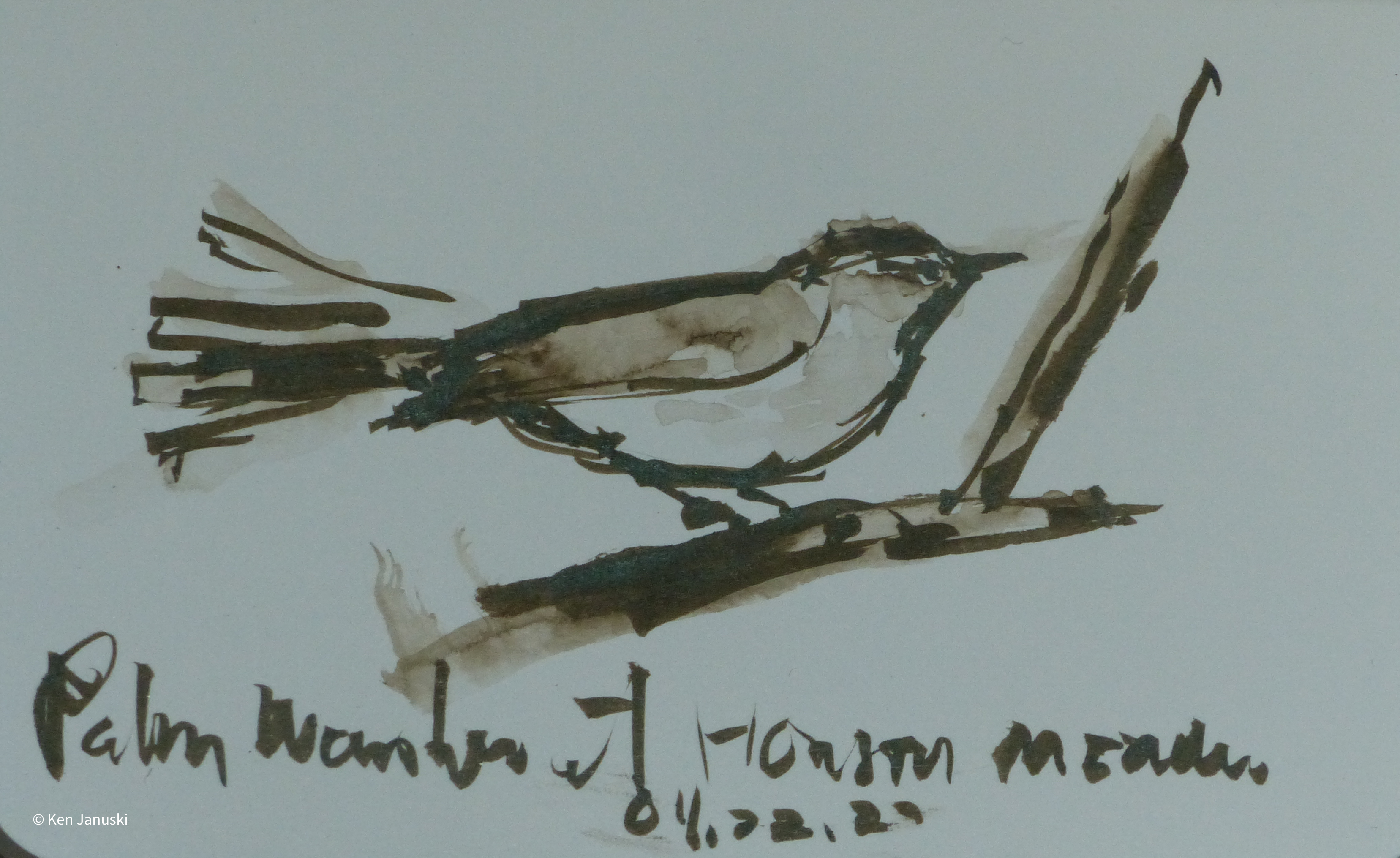
Sumi brush pen field sketch of Palm Warbler, the first seen this year. Copyright 2022 by Ken Januski.

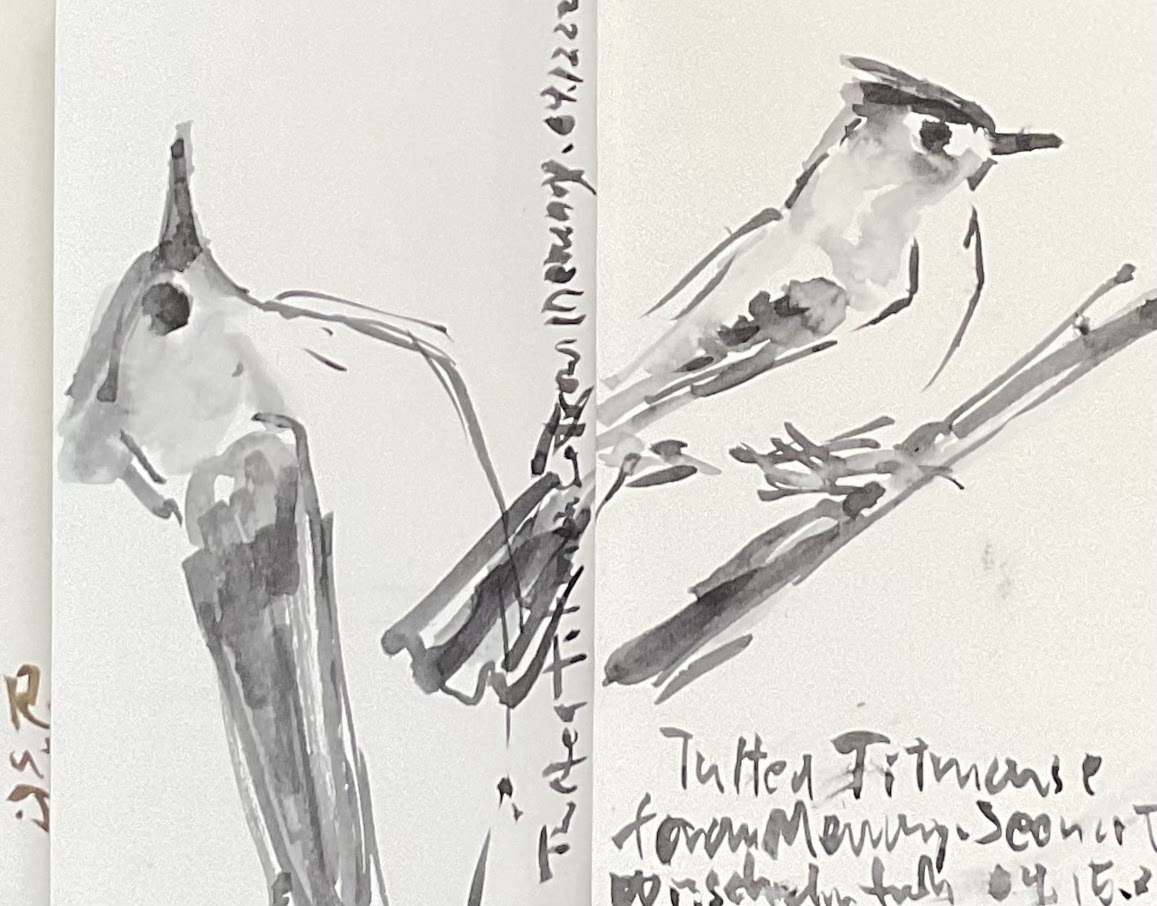
Sumi brush pen field sketches of Tufted Titmouse by Ken Januski. Copyright 2022.

Sumi brush pen field sketch of Yellow-rumped Warbler seen today at Houston Meadow. Copyright 2022 by Ken Januski.


Because I often switch media, or often styles within the same medium, I may look a bit flighty or at least not committed to a particular medium, such as moku hanga. I have wondered about this. And I've decided that my commitment is to a subject, the natural world in particular birds.

During my formal artistic education the last thing I wanted was subject matter. I could be pretty ruthless in making sure that there was none, not even any vague reference to something from the physical world. But over time I decided that this was just silly. You have just as much artistic freedom with a subject as without one, and all in all I think subject matter both makes the art more interesting and more rewarding.

So my art may lack much continuity of medium over the last 10-15 years. But it has a very strong continuity of subject and I'm perfectly happy with that.

Tuesday, November 5, 2019

A New Moku Hanga Print; Return from SWLA Annual Exhibition

Least, Solitary and Spotted Sandpipers. Moku Hanga print by Ken Januski. 10.5x8.5 inches. Printed in 2019 on Echizen Kozo paper.

It's taken quite a while but I've finished my eighth moku hanga print: Least, Solitary and Spotted Sandpipers. The entire print as 10.5x8.5 inches and it's printed on Echizen Kozo paper. I haven't sorted out what prints will be in the edition but I expect it to be around 25.

I originally planned the print to be on Nishinouchi paper and spent forever proofing various versions on it. But after I'd started printing I realized that I had no Nishinouchi paper left other than the first 12 or so prints that I'd already printed. Since I was soon leaving on vacation I didn't want to leave it on hold until I got back and new paper arrived. So instead I did a small version on Echizen Kozo. Echizen Kozo is a much more expensive paper but still I was shocked at how much more I preferred the resulting image. So when I returned from vacation I continued printing on the Echizen Kozo. Though I like the Nishinouchi version I don't think I have it in me to go back and print a larger edition on it. One thought I have had about the two papers is that I might prefer the appearance of the Echizen Kozo when I leave a fair amount of bare paper on the print. For prints where there is little or no bare paper Nishinouchi may be fine. I do know that I've been happy with it on some earlier prints.

Below is both the version on Nishinouchi and a photo of about half of the edition on Echizen Kozo.

Least, Solitary and Spotted Sandpipers. Moku Hanga print by Ken Januski. 10.5x8.5 inches. Printed in 2019 on Nishinouchi.

Twelve of the entire printing of 30 prints on Echizen Kozo paper. Some will be culled for a final edition of around 25.

I decided to use these shorebirds as the subject of a new moku hanga print soon after drawing some Spotted and Solitary Sandpipers from life at Morris Arboretum. They are not the best field sketches I've ever done but along with some similar field sketches from May of this year they were the inspiration for this print. I think I like them because I know that they are an honest response to a bird that is right in front of me.That type of inspiration I almost never find in my photos. For me it remains true that my art inspired by photos looks exactly like that: art inspired by photos, not by real life. Below are some of those field sketches.


Sumi brush pen field sketch of Solitary Sandpiper at Morris Arboretum. By Ken Januski.

Sumi brush pen field sketch of Spotted Sandpiper at Morris Arboretum. By Ken Januski.

Sumi brush pen field sketch of Spotted Sandpiper at Morris Arboretum. By Ken Januski.


Sumi brush pen field sketch of Solitary Sandpiper, feeding Wood Ducks and dragonfly at Morris Arboretum. By Ken Januski.


Late this summer I also did some sketches from photos of both Spotted and Solitary Sandpipers. I didn't do them with any intention of preparatory sketches for a print but just because I wanted to study the structure and movement of the birds. They are below.

Sumi brush pen sketches of Solitary Sandpipers by Ken Januski.

Ball point pen sketches of Spotted Sandpipers by Ken Januski.

Sumi brush pen sketches of Spotted Sandpipers by Ken Januski.


Most of the motivation for this print came from seeing and sketching Solitary and Spotted Sandpipers from life. As I began the sketch for the print I decided to put in another shorebird that I've often sketched from life, the Least Sandpiper. I'm not including any of those sketches since they are from a few years ago. When I did start sketching the preliminary drawing for the print I also used some of my photos, but only after all of those field sketches.

Once I started the actual print though more formal considerations took over: how does the print look? Do those colors and shapes work together, etc., etc. It's these types of decisions and the many, many proofs that accompany them that make my prints take so long to complete. I used to take forever to complete large abstract painting. Now I seem to be doing the same with prints. Even when I try to be quick, as with the Great-crested Flycatcher shown in an earlier post it seems nearly impossible!!

A few days after we returned from Cape May 'The Natural Eye', the annual exhibit of the Society of Wildlife Artists opened in London, UK. I'm happy to say that all three of my prints were accepted for the show, though sadly enough none of them sold. A review of that show on the Making A Mark blog is here. Though we couldn't see that show in person this year the many photographs available online show what an exhilarating show it was once again. Mall Galleries has an online gallery of the show and this is a link to my Purple Finch and Hairy Woodpecker print. I have links to some photos, including 80+ by Making A Mark, on my Ken Januski Artist Facebook page. One of  the many things I like about the show is that in it many artists also look like they spend a lot of  time working on their artwork. By that I don't mean the man-hours that I often see artists boasting about as though that has something to do with the quality of their art work. It doesn't, unless in inverse proportion.What I mean is that they don't go for cliches, formulas, etc., etc. So much of the work looks like a real artist created it, someone interested in creating something fresh and individually expressive!