Showing posts with label Bobolink. Show all posts

Monday, September 5, 2022

Ambition in Art

Brant and Black-bellied Plover on Nummy Island. Moku hanga print by Ken Januski, Copyright 2022.


One of the hazards of writing anything online is that eventually someone will read it. Of course the purpose of a blog, much more than social media I'd say, is to have people read it, not just like it but read it. The problem, at least if you're a person somewhat like me, and have some sense of conscientiousness, is that I may find that I disagree with what I've written, sometimes almost immediately after writing it.

What got me started on this was mentioning "ambition" in my last post. I mean exactly what I said. I missed the ambitiousness of much of my abstract work once I switched to more naturalist work. I also missed it in printmaking, especially moku hanga, at least my own moku hanga. One of the rewards of the International Moku Hanga Conference was seeing ambitious work by others. The same could also be said for the work at the annual exhibitions of the Society of Wildlife Artists, in which I've often been fortunate enough to exhibit.  Both have examples of ambitious art.

So what's the problem? Well the problem is that there is a lot of art that I like and admire that is not particularly ambitious. And there's also the problem, which I'll spare you showing visual examples of from my own work, where ambition just leads to constipation. It can become very stilted!


Leaping Eastern Cottontail at SCEE. Sumi brush pen and water brush painting from memory by Ken Januski. Copyright 2022.


The very quickly done(3-5 minutes) drawing from memory above is very exciting to me. It tries to capture, and does I think at least to me, the living leaping rabbit in front of me. I saw this rabbit at the Schuylkill Center for Environmental Education last week where it was here and gone in less than 30 seconds.  But is this drawingt ambitious as the term is usually used in art? Probably not. But what could be more ambitious than trying to get a feel for the actual encounter with an animal, or a person for that matter? But I didn't consider it ambitious when I did it. It was just something that I wanted to do. And I think that there is a lot of similar art, though probably much more 'realistic' than mine, which couldn't care less about ambition but just wants to capture something of what it sees, and perhaps feels.

On the other hand I think that there is a large audience for art that mainly values the subject, in my case animals most of the time, but has little or no reaction to how it is portrayed except perhaps by a photographic yardstick. "OMG I thought it was a photo!!" Though this is an honest expression of appreciation most times, or so I'd guess since I've never used it myself, it probably is not exactly welcome to the ears of the artist, unless he or she is trying to imitate a photo.

Many artists, and I'm sure also musicians, actors, and also craftsmen of whatever sort, can get bored with the language/tools they've been given to. work with. Almost as soon as they put pen to paper, chisel to stone, tomato sauce in pan, etc., etc. they fear that they're creating a cliche. I'm sure this doesn't affect all artists and craftsmen but I think it does affect a lot. Those artists want to refresh their art. What they do is first disliked my most, even their peers, eventually accepted by their peers, then by the general public, then appears on shopping bags and in commercials, where it is not even truly seen or heard anymore and some new artist will try once again to freshen the medium he uses. This is what I would call the good side of ambition in art. It really is a passion to express something that the language of the art currently doesn't seem to be able to say. (As and aside I most recently read about this in an explanation of Charlie Parker and his music. He wanted to play what he heard in his head but wasn't being played by anyone else). That is ambition born of passion.

There's also ambition I'm afraid born of the academy, and every age has its academy, though it may not know what it is. The Impressionists were the enfant terribles of their day, reacting against salon painters. But every age has an academy and many artists are ambitious within the constraints and goals, spoken or unspoken, of it. This to me is a bad type of ambition because it really is just art that tries to mimic other 'successful' art of its time. I'm sure most artists can think of examples of artists they know, sometimes successful ones, who seem more to be copying more or less someone who is currently successful, rather than developing their own artistic voice.

I haven't been to art school in ages so who knows what is taught today. But I wouldn't be completely surprised to hear at least some teachers suggesting that artists develop their own voice. This is something I'm pretty sympathetic to but I'm not sure every artist will fare well with that goal. "Uh, oh, is this really me? Am I copying someone else? Is it slightly derivative? Etc., etc." I did spend some years in graduate school where such questions seem to turn artists into deer in headlights, sometimes including myself. I don't want to go to far afield but I would say that this can be another example of ambition in art being bad for some artists.

Perhaps some artists should just do what they love and go from there. The Society of Wildlife Artists mentions something about 'encouraging appreciation and delight in the natural world' on their web site. I think this means to highlight nature rather than art, though I could be wrong. And in some ways I think I must be because much of the art shown there is delightful, and that delight I think is created by a collaboration between artist and nature. The artist has to notice what is delightful AND find a way of expressing that. This is another form of ambition in art, but one like ones I mentioned earlier that stems from passion.

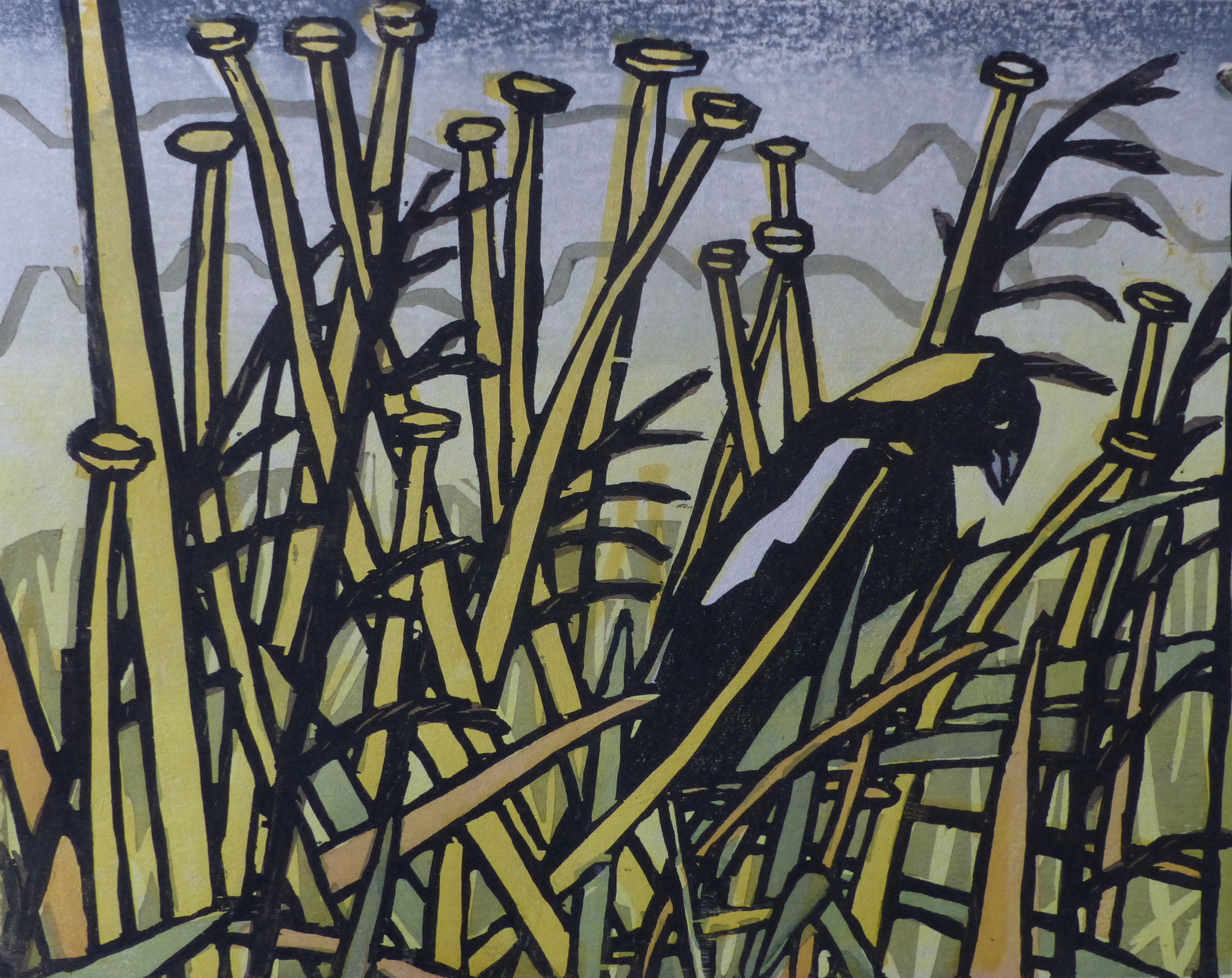
And on that SWLA note I should add that I'm quite happy to have had two of my works chosen for the annual show in London in mid-October. My new moku hanga of the Brant and Black-bellied Plover at top of this post is one of the works. The other is my next to last moku hanga: Bobolink at Dixon Meadow shown below. I was tempted to submit my more recent Nashville Warbler on Bean Trellis in Winter, which I still really, really like! But it doesn't seem to have been particularly popular  and the costs involved with shipping and couriers have made me limit my entries to just two.

Bobolink At Dixon Meadow Preserver. Moku hanga by Ken Januski, copyright 2021.


Monday, June 13, 2022

Two (Moku Hanga) for 2022


Original Moku Hanga of Nashville Warbler on Bean  Trellis in Winter. Copyright  2022 by Ken Januski

Original Moku Hanga of Bobolink at Dixon Meadow. Copyright 2022 by Ken Januski.

I've finally finished my second Moku Hanga of 2022, this one a revisit of my first one ever: Nashville Warbler on Bean Trellis in Winter. I don't believe I ever showed the final version of the Bobolink at Dixon Meadow so I'm showing it as well.

It's not surprising that I did another version of the Nashville Warbler. Being my first moku hanga ever and being done with exactly no training in the art/skill/process it came into being more through will power, trust in my artistic abilities regardless of medium as well as sheer terror at all that was going wrong as I proceeded trying to print an edition!! And yet I still liked it, and it seems some other people did as well. But there was absolutely no consistency from print to print so I removed it from sale.

In the five plus years since I made the first version I've learned a lot. As I think I wrote previously about the International Moku Hanga Conference last December I learned a lot from presentations there, but I also had my ambitions raised. As with wildlife art when I first ran into The Society of Wildlife Artists I had to run into some accomplished artists in the field to see all that was possible and also I'd say to translate the ambitions I used to have in my abstract work into wildlife art, except here it was to moku hanga. One of the surprising things about the conference and other smaller online meetings that were an outgrowth of it was the discovery of what a great variety of accomplished and contemporary moku hanga there is out there in the world.

All of that I think informed these prints, as well as my continued desire to portray the natural world, something for which I don't make the slightest apology. If you're not smart enough to see that it is just as valid as any other 'subject' that is your blindness, not my anachronistic romanticism about nature. I think just about anything can be the subject of art, including wildlife.

But that is a bit of tangent. I really don't have a lot to say about these prints except to say that in the newest one I did a lot of experimenting on the background. I wanted it to be vibrant but I also wanted it to evoke in some way the very inhospitable weather we had when the Nashville Warbler was in our yard many winters ago. In that experimentation I  ended up varying what I printed even in the final edition. So these prints will be called e/v for Edition Varie. But I also found that I was getting tired of tossing prints from the edition, often each of which might have a few hours devoted to it, because of small blemishes.

I can understand the tradition of only choosing prints that are identical, that are without blemish of any sort, etc., etc. If I'd trained as a printmaker perhaps I'd believe in it as well. But it seems to be that there is a tyranny there, that values the skill of the printer over the artistic quality of the artist, who sometimes is the printer as well, especially in most modern moku hanga.

In fact almost everything is done by hand, by one person in modern moku hanga. I'm just guessing but with five blocks on my new print, multiple printings of some of the blocks and multiple colors as well on some that this leads at least to 10 impressions for each print, 10 times that something can go wrong, often just the slightest thing. I have been relatively strict in culling out prints in the past that have had very minor blemishes. But I'm getting more and more reluctant to do so given the work involved. So when I finally number the edition of the Nashville Warbler I may include more prints that I normally would. I think that this is a step in the right direction.

Otherwise I think printing can just become too inhibiting and just not worthwhile from an economic perspective as well as psychological perspective. Rules should not stamp the joy out of it. This I'm sure will rankle at least some print collectors. But my feeling toward them would probably be the same as it is to those art collectors who won't accept any thing out of order in the feather details of birds. Those demands are just too inhibiting I think for the serious artist to bother with.


Monday, February 7, 2022

Craft, Technique, Mokuhanga

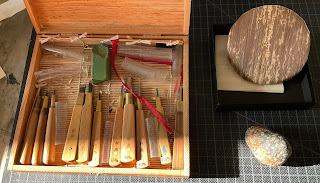
My carving tools for moku hanga, including a newly sharped aisuki chisel. Along with baren that has just been newly wrapped in bamboo sheath. The bamboo was softened before wrapping using the stone at bottom right.

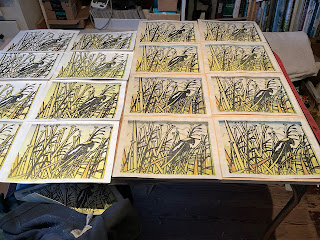
Most of the proofs I made as I developed the moku hanga of the Bobolink at Dixon Meadow Preserve. I will start printing edition today or tomorrow.


I had a great revelation today. After thinking about a new blog post that would talk about the 4th International Mokuhanga Conference as well as the craft and technique that is part of mokuhanga I kept coming up with this big caveat:  I generally don't like technique in my work or anyone's.

The revelation, at least to me if not necessarily the rest of the world, is that craft and technique are different! Though I've never really cared about technique and did not have an artistic education that stressed it I nonetheless have always been appreciative of tools, of any sort, and learning how to appreciate them and use them as they were made to be used. There is a great sense of both accomplishment and also something akin to moral grounding in appreciating a good tool and learning how to use it for its intended purpose. Good tools are a gift to humanity, just like art and nature.

Today I finally realized that craft is learning how to use the tools of your craft. In mokuhanga in particular    it means that you learn, slowly, how to use the various carving tools, and also how to sharpen them, learning how they differ from most western-style tools. I have no problem at all with this type of craftsmanship. It's necessary first off. You can't do much carving if you don't have sharp tools and know how to use them. But it also entails I think an appreciation for the maker of the tools, especially all the hand tools that are used in mokuhanga, as well as for their history. Back when I dabbled, and I do mean dabbled, in fine carpentry,  I loved buying using chisels and planes from the 1800s or earlier(always at a very cheap price I should add). I had gotten tired of power tools, which probably are necessary if you need to work quickly, but otherwise are to me just a pain. There is something much more rewarding, though with a learning curve, in hand tools, like chisels and planes. But in addition I just got a real kick out of using a 19th century plane once used by someone in France, or a chisel used in England or early America, etc., etc. You are holding a piece of history and also continuing it. 

Craft also means I forgot to mention learning about how barens work, how the wood you carve works, in particular how Japanese paper works. The recovered baren at top would look quite amateurish if I turned it over so you could see how the bamboo ends are tied off among other things. But it's something I've been dreading doing for quite a while and yet I knew that you really have to learn how to do it. Your bamboo cover will eventually develop problems and they will damage the much more expensive coil that is beneath the bamboo cover. This is my second recovering. The first was adequate but the bamboo had cracked just outside the surface of the baren. I knew it was only a matter of time before it migrated onto the surface and would cause me to stop printing and replace it. Since I was about to start printing the edition of the bobolink I decided it was best to do my second recovering before I started. It has been more than adequate and I'm finally experiencing what others have talked about, the feeling of great sensitivity in the baren. So these are just some aspects, at least to me, of craft in mokuhanga. I guess you could say that learning how to print a good bokashi(shading) or many other types of. surfaces is also a craft. And I think that is true. Bokashi is also a tool in your toolbox, though it was one that for a long time I really couldn't see myself using. But I think this may be where the confusion comes. Having the ability to print a good bokashi is having the craft of bokashi. But often it seems that it. is used more to show that you can do it rather than because the print calls for it. Then it becomes technique.

Technique. as distinguished from craft, seems often to just mean facility. Facility is of course useful. But there are often times where facile is also soulless. Artists I think know this, but audiences often don't. In any case that is why I've been ambivalent about craft in printmaking and especially moku hanga. Now I realize that I'm not ambivalent. I like and appreciate craft in printmaking and moku hanga. It's technique that has become facile that I don't like. (I should add that when I first started making wildlife art I used a very vigorous compressed charcoal and heavy erasure method of working. I'd used it for years in my abstract work and I was sure that my facility in its use would cover my very significant ignorance of the structure of birds. It worked I think but it was a dead end. So I forgot about and instead spent years going back to the remedial work of figuring out how birds are put together. But I did abandon ship on my facility with charcoal).

I should add that I think that there is a fair amount of facile technique in printmaking, which perhaps has something to do with my never being totally taken with it. But it's not necessary to printmaking. I don't want to get off on a tangent so I'll just say in summary that much printmaking, though less so moku hanga I think, seems musclebound. The soul of the artist is buried under the avalanche of technique.

Enough! Now back to Moku Hanga and the 4th International Moku Hanga Conference. I felt both odd and apprehensive about applying for the Sumi-Fusion Exhibition that was part of it. Though I'm now in my sixth year of moku hanga printing I've also done painting and sketching during that time. I've certainly not been fully involved in it. And I've never studied it with anyone. Finally I know that I have mastered neither craft or technique. So in many ways you could say I'm an impostor.

On the other hand since the first time I tried it I fell in love with it, in spite of the huge number of travails along the way. So I decided to apply for the exhibition and also register and pay my fee for largely but not completely virtual conference. My understanding is that the actual conference was open to anyone living in Japan but due to the pandemic was not open to outside visitors.

Practically speaking I have to say the organizers did a tremendous job. I have always avoided Zoom but finally was baptized at the conference. It was the only way to participate, or even just to watch presentations and discussions live. For me there were almost no technical problems. I could see almost any demonstration or talk that I wanted to. When you consider that the conference had to be set up so that people in a least 3 major time zones could do so it really seems like an amazing technical feat.

But technology was not my main concern. I just want to note what an accomplishment it was. My first goal I think, outside of happily having my work accepted to the exhibition, was to learn some craft. I really wanted to know more about sharpening tools, using barens effectively and also recovering them in bamboo, which is often necessary. There were great video demonstrations on these topics that I've watched over and over.

What I didn't really expect to gain was an appreciation for the wealth of types of contemporary mokuhanga as well as the variety of people from all over the world. This was really a pleasant surprise. And there was something more. Seeing real mokuhanga artists!

This may seem silly. What do I mean? Even though I made art from an early age I never really thought I could be an artist. As far as I know there were none in the town where I grew up. Even when I went to college and made very regular visits to a major museum in a large US city I didn't connect with artists whose works I saw in the museum. They were from history not real life. It was only when I ended up going to college in the San Francisco area studying studio art that I met real artists who were making a living from their art: real life artists! It seems silly but sometimes you just have to see such things to believe that they are possible. The same was true though to a lesser extent with seeing so many mokuhanga artists and seeing them talk about their work. It just gave me a much greater appreciation of mokuhanga as a living breathing thing.

Seeing so many people talk about mokuhanga also reinforced some of my own feelings: that it is a natural way to work, using natural materials, largely without the use of toxic chemicals. It's always struck me as very organic and earthbound and that feeling was largely corroborated by many of the artists who gave talks or demonstrations. Though I don't think it was mentioned all that much I do think I heard others say what I've often felt: that you are in total control with mokuhanga. You don't need an expensive, heavy, bulky printing press. Your press is you, your baren and the table in front of you. There is so much control of the process at your fingertips.

Total control is of course good and bad. When things go wrong you generally can't blame the press or anyone/thing other than yourself. This happened to me just the other day when I went to fine-tune the carving on a woodblock. Thin previously carved lines kept breaking on me. That's most likely because is has been so dry here. But it is something that people learn to work around. You don't have to stop printing while awaiting delivery of a repair part for your press.

Having seen many Society of Wildlife Artist's Exhibitions online, attended one in person and having shown in many I couldn't help comparing the two though they are different in that one is primarily an exhibition and the other a conference that includes an exhibition(s). What struck me is the variety of subjects in the papers given at the conference: some were quite historical with one considering the effect of new pigments on the quality of ukiyo-e prints, another, if I remember correctly, Tibetan carving in relation to mokuhanga. I would not at all suggest that papers start being given at SWLA but I do have to say that it was a fascinating experience to see so many people connected to mokuhanga in so many different ways. I wish that I had had time to watch all of the presentations, even though most are still online today. I just have not had the time. And of course there was Zoom fatigue.

But all in all I couldn't have been happier with the conference. There was a tremendous amount to digest and I have to thank everyone involved for making it possible.

If there's anything I regret it's not being able to visit the sumi ink shop which actual visitors were able to do. I've always loved sumi, well at least since I first used it, and it would have been fascinating to see. Having never been to Japan, and with no immediate plans to do so, I do have to say nonetheless that it has become much more of an interesting place to visit. I started reading a history of Japanese art right around the time the conference started. That also has piqued my interest, in particular in architecture, something that Nara which hosted the conference seems to have plenty of. Well perhaps next time!

Finally, back at the very top, are some pictorial examples of craft in mokuhanga. The first photo shows my carving tools, including a newly sharpened aisuki chisel and a newly wrapped baren. This one worked much better, though it is still amateurish, because I used the stone at bottom right to soften the bamboo before covering. The second photo shows many of the proofs of my current mokuhanga. I hope to start printing today or tomorrow.

Monday, December 30, 2019

Cape May Field Sketches - Part Seven

Sumi brush pen sketch of Black-bellied Plover at Nummy Island, by Ken Januski.

We visit Cape May, NJ at least once a year most years and during that visit I almost always do some field sketches. For many years I've also posted some of them here. But it seems like I've not done so in a number of years and 2019 is rapidly disappearing.

So, hoping that my post doesn't get eaten by Blogger as happened the other day with my last post, I'm trying for a quick one that will mainly just have captions  on  the various drawings. These are not photographic studies. They are generally done very quickly, before the bird changes position or flies off. Sometimes they are hard to  do. A photo is so much quicker and easier. But photos always lack in liveliness. For me there's nothing more exciting than field sketches, mine or those of others. And if I ever do use photos it's always because I feel like I've really gotten acquainted  with the bird through  sketching. That allows me to take some liberties with any photos I might use.

Sumi brush pen sketch of Black-bellied Plover at Nummy Island, by Ken Januski.

Sumi brush pen sketch of Boat-tailed Grackle staring up at Double-crested Cormorant at The Wetlands  Institute, by Ken Januski.

Sumi brush pen sketch of five American Avocet at South Cape May  Meadows, by Ken Januski.

Sumi brush pen sketch of juvenile Hudsonian Godwit at Nummy Island, by Ken Januski.

Sumi brush pen sketch of juvenile Hudsonian Godwit at Nummy Island, by Ken Januski.i.

Sumi brush pen sketches of various shorebirds and Least Tern, the latter at Two Mile Landing, by Ken Januski.

Sumi brush pen sketch of male Bobolink at Garrett Family Preserve, by Ken Januski.

Sumi brush pen sketch of Least Terns at South Cape May Meadows, by Ken Januski.
Sumi brush pen sketch of Horseshoe Crab, Red Knot and Laughing Gull at Reed's Beach, by Ken Januski.


Sumi brush pen sketch of sitting Pectoral Sandpiper at South Cape May Meadows, by Ken Januski.

Sumi brush pen sketch of three of 140 Black Skimmers at South Cape May Meadows, by Ken Januski.

Sumi brush pen sketch of three Whimbrel at Two  Mile Landing, by Ken Januski.

Sumi brush pen sketch of two American Avocet at South Cape May Meadows, by Ken Januski.

Sumi brush pen sketch of Wild Turkey at Belleplain State Forest, by Ken Januski.

And since I seem to have made it through this entire post without technical hiccups I'll celebrate by wishing all readers a Happy New Year. I should add that I hope Blogger will survive. I hesitated devoting more of my energy to Facebook than it for years until I realized most of the people whose work I was interested in were on Facebook and most of my own Blogger readers seemed to be bots and other undesirables. But Blogger offers much that Facebook and other social media does not. Hopefully it and its audience will come back to life.